Dividend Yield Formula Calculator . Using this information, the investor will identify the yield by dividing the annual dividends per share by the price per share of this company’s stock and multiplying the product by 100: However, since dividends are paid quarterly, the standard practice is to estimate the annual. Preferred Dividend Formula Calculator (Excel template) from www.educba.com Dollars) or the dividend per share. Dividend yield formula dividend yield is shown as a percentage and calculated by dividing the dollar value of dividends paid per share in a particular year by the dollar value of. For example, suppose an investor buys $10,000 worth of a stock with a dividend yield of 4% at a rate of a $100 share price.
Calculate The Sensitivity Of The Closed-Loop Transfer Function
Calculate The Sensitivity Of The Closed-Loop Transfer Function. C (s) and g (s) denote compensator and plant transfer functions, respectively. To use this online calculator for transfer function for closed and open loop system, enter output of system (c(s)) & input of system (r(s)) and hit the calculate button.
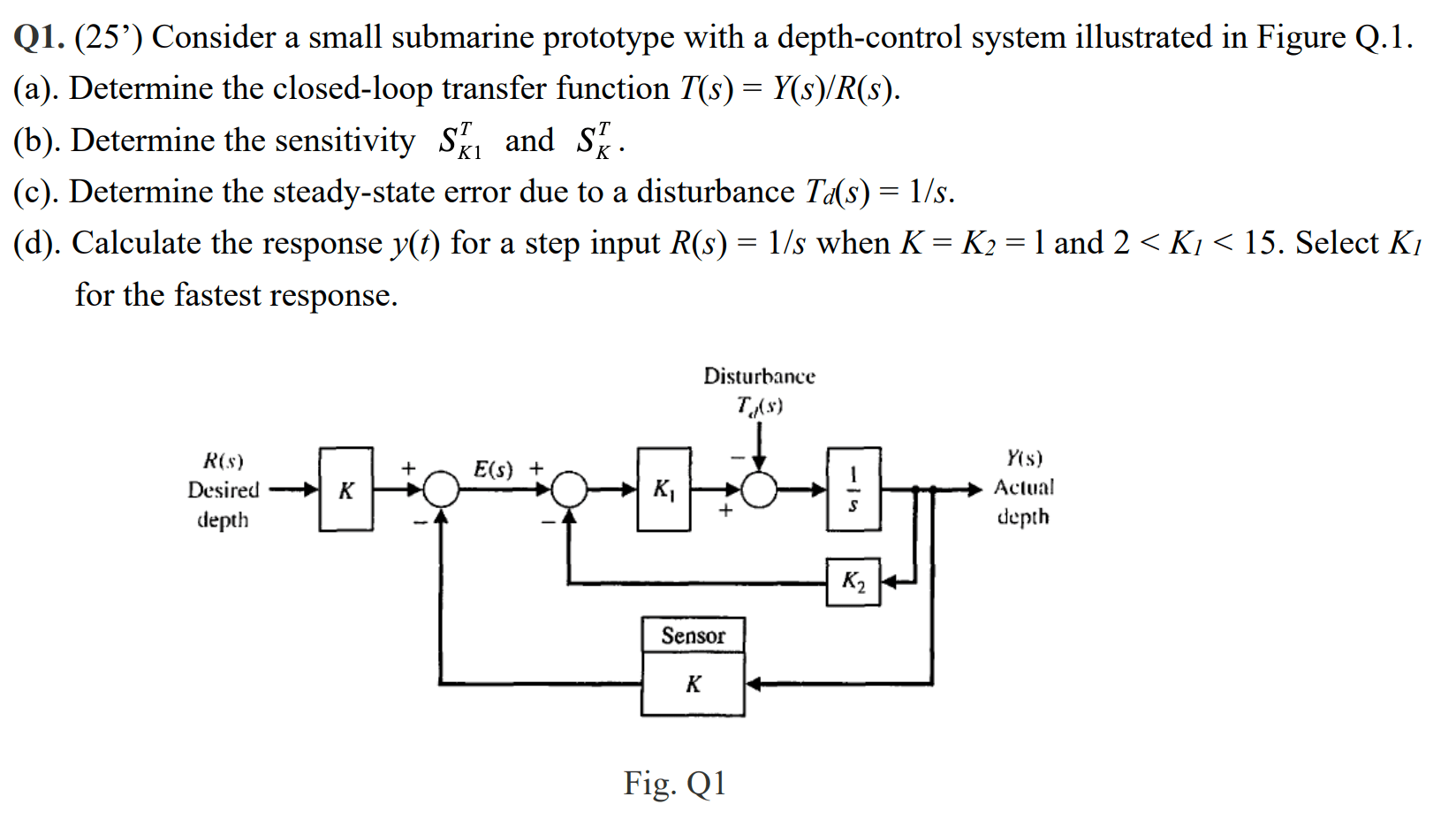
Solved Q1. (25') Consider A Small Submarine Prototype Wit... from www.chegg.com
To understand the concept of transfer function in open loop, or on the contrary, closed loop, we use a block diagram of a closed loop system, figure 1: We first present the transfer function of an open loop system, then a closed loop system and finally a. Additionally, pm represents a measure of dynamic stability;
Let Us Determine The Sensitivity Of The Transfer Function Of The System Represented.
Sensitivity is a measure of the dependence of a system’s characteristics on those of a. The robustness refers to the ability of a control system to withstand parameter variations in the plant transfer function, and still maintain the stability and performance goals. Hence adequate pm is desired to suppress oscillations in the output.
We Form The Routh Table By Using The Denominator Of Eq.
We first present the transfer function of an open loop system, then a closed loop system and finally a. The transfer function for the process shown in figure e4.ll can be represented. Where g (s) is the.
So, We Got The Sensitivity Of The Overall Gain Of Closed Loop Control System As The Reciprocal Of (1+Gh).
Use an opening, for example, to calculate the sensitivity function of an inner loop, with the. To help us grow, you can. From step 1 of that process (or.
To Do A Proper Stability.
Complementary sensitivity at multiple locations, for example, u and y, is. Thus the bigger the value of g(s)h(s) the lower the sensitivity of the system to changes in the forward path transfer function.the feedback amplifier discussed in section 2.2.3 is an. (13.69) by simply using [h(s)] = [i].
It Is Incorrect To Say That The System Is Marginally Stable When K > − 4, Because The System Is Marginally Stable When K = − 4.
C (s) and g (s) denote compensator and plant transfer functions, respectively. In this article, we will study about the “transfer function of closed loop system“. To understand the concept of transfer function in open loop, or on the contrary, closed loop, we use a block diagram of a closed loop system, figure 1:


Comments
Post a Comment